Table of Contents
I’m going to take a guess: your Instagram feed is beautiful. It’s full of photos of your baby in a stroller by the Nervión river, or maybe a snapshot of a café con leche in a sunny plaza in San Sebastián. Your friends back home comment, “You’re living the dream!”
And you are. Mostly.
The Osakidetza (Basque health system) has been great. You had those lovely English-speaking midwives (matronas) who supported you through your birth. Your partner is hands-on, the baby is healthy, and the mountain views are breathtaking.
So why, at 3:00 PM on a Tuesday, do you feel like you’re the only person left on earth? Why does it feel like there’s a heavy, grey fog in your living room that even the Basque sun can’t burn off?
If you’re feeling lonely even when “everything is fine,” I want you to take a deep breath. You aren’t ungrateful. You aren’t failing. You’re navigating Motherhood and Migration at the same time, and that is a combination that would tire out even the strongest woman.
1. You Gave Birth in a Different Language
In the Basque Country, you might have an amazing English-speaking midwife at your local clinic, but as we know, she’s rarely the one in the delivery room. This “resetting” of your support system over and over—explaining your birth plan, your fears, and your history to a rotating cast of strangers—makes you feel like a “case number” rather than a woman being seen.
2. The Ghost of Your Mother in the Kitchen
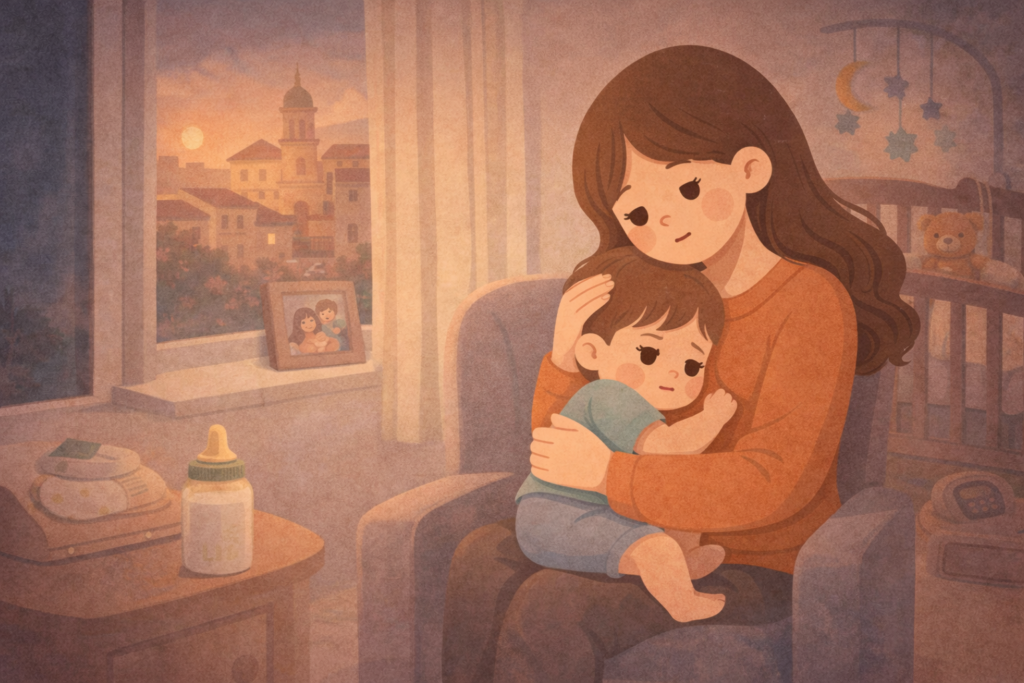
This one is heavy. It’s a quiet, persistent ache that sits in the corner of the room while you’re nursing at 3:00 AM.
After giving birth in the Basque Country, you’ll find the medical care is very “matter-of-fact.” The Osakidetza midwives are wonderful—they check your physical recovery, they monitor your stitches, and they weigh the baby with clinical precision. But the system is designed for women who have a village waiting for them at home.
In Euskadi, the “family unit” is a powerhouse. Most local moms head home to a mother who has a pot of alubias on the stove and a hand ready to take the baby so they can nap.
But you? You’re navigating the “Fourth Trimester” without your mirror.
- You don’t have the woman who knows your “tired face” better than anyone else.
- You don’t have her in the kitchen making the food that tastes like safety.
- You don’t have anyone to say, “Go sleep, I’ve got this,” with that specific authority only a grandmother has.
The healthcare system here can fix your body, but it can’t sit on the edge of your bed at 2:00 AM and tell you that you’re doing a great job in the language of your childhood. That kind of loneliness is invisible, but it’s deep.
3. The “Double Rebuild”: Starting from Zero
When you have a baby in your home country, you are adding a new chapter to an existing book. Your friends are there, your favorite supermarket is around the corner, and you know exactly how the world works.
When you become a mother in the Basque Country, you aren’t just raising a human—you’re rebuilding your entire identity from scratch. You are going through a double transition:
- Learning to be a mother.
- Learning how to “be” in a new culture.
It is exhausting to be a “newbie” in two worlds at once.
4. The Guilt of “The Dream Life”
Because you live in a safe, beautiful place with good healthcare, you feel like you aren’t allowed to complain. This “gratitude trap” keeps you silent. And silence is the fuel that loneliness burns to stay alive.
5. The Micro-Cultural Disconnect
Maybe the local moms at the park give their toddlers bread at 8:00 PM, and you’re used to a 6:00 PM bath time. These tiny cultural differences remind you every single day that you are “the other.” Your husband might not notice these nuances, but as a mom trying to fit in, you feel them like sandpaper.
6. The “Middle-of-the-Night” Time Zone Gap
When the baby won’t sleep at 3:00 AM in Vitoria, your “village” back home is either eating dinner or fast asleep. You look at your phone, desperate to text someone who “gets it,” but the time zone makes it impossible. In those hours, it’s just you, the baby, and the silence of the Basque night.
7. Your Partner is Your Only Person
This is a heavy one. Because you’re an expat, your husband often becomes your best friend, your therapist, your co-parent, and your only social outlet. That’s too much pressure for one relationship! When he’s tired or has a bad day, your entire support system effectively collapses.
8. The Loss of the “Old You”
In your home country, you had a reputation. You were the “funny one,” the “career woman,” or the “reliable friend.” In Spain, you might just be “the foreign lady with the stroller.” Rebuilding who you are while also being a 24/7 milk machine is an identity crisis that no one warns you about.
9. The Cultural “Slow Burn” of Euskadi
Let’s be honest: the Basque people are some of the most loyal, wonderful friends you will ever have—once you’re in. But getting “in” takes time.
In many cultures, “mom friends” are made instantly at the park. In the Basque Country, social circles (cuadrillas) are often formed in childhood and stay tight for life. As an expat mom, walking into a playground where everyone has known each other since they were five years old can feel like trying to break into a vault.
Even if you speak decent Spanish, the local pace, the dialect, and the deep-rooted family structures can make you feel like you’re watching a movie through a window. You’re there, you can see it, but you aren’t quite in the scene.
10. The Partner Who “Integrates” Faster
Does your husband go to the office? Does he have coworkers to grab a caña with? Even if he comes home and helps, he has a social tether to the Basque world that you might lack. While he’s talking “shop,” you’re at home with a baby, feeling like the world is moving on without you in a language you’re still mastering.
Why “Good Enough” Isn’t Enough
I remember my own birth experience here. The midwives were so kind, and they really tried with their English. My partner stayed by my side the whole time. But when the lights went down in the hospital room, I still felt a hollow ache.
I realized then that support is not the same as connection. You can have the best medical care in Euskadi and the best husband in the world, and still feel like you’re starving for someone who just knows you without you having to explain yourself.
How to Find Your Footing Again
If you are feeling this right now, please hear me: It is not because you aren’t “integrated” enough or “tough” enough. It’s because you are doing something incredibly hard.
- Seek out the “International Village”: While it’s great to have local friends, you need other expat moms. You need the women who understand why you miss certain brands of peanut butter or why you’re confused by the school schedule. We are out here!
- Lean into the “Matrona” Postpartum Sessions: Even if your Spanish is shaky, go to the talleres de lactancia (breastfeeding workshops) or postpartum check-ups at your centro de salud. Even if you feel shy about your Spanish, go. The shared language of “tired mom” transcends vocabulary.
- Keep Your Culture Alive: Don’t try to be “100% Basque” overnight. Cook your comfort foods, play music from home, and speak your native language to your baby. Your heritage is your anchor.
- The 10-Minute Rule: When the time zone makes calling home hard, send voice notes. Hearing a familiar voice—even if it’s not live—reminds your brain that you are loved.
You Are Doing Something Brave
Motherhood abroad is not just raising a child; it is rebuilding yourself in a new land. Every time you navigate a doctor’s appointment or strike up a conversation at the playground in San Sebastián, you are being incredibly brave.
I want to hear from you:
- Which of these reasons resonated with you most?
- Did you have a “matrona” experience that felt lonely, or did they help you feel seen?
Comment below and let’s break the silence together.
Join Our Village 🌿
You don’t have to do this alone. If you’re looking for a community that understands the specific highs and lows of being a mom in Spain, come join us. We share the real stuff—the doctor recommendations, the “where to find peanut butter” tips, and the 2:00 AM “is this normal?” questions.